
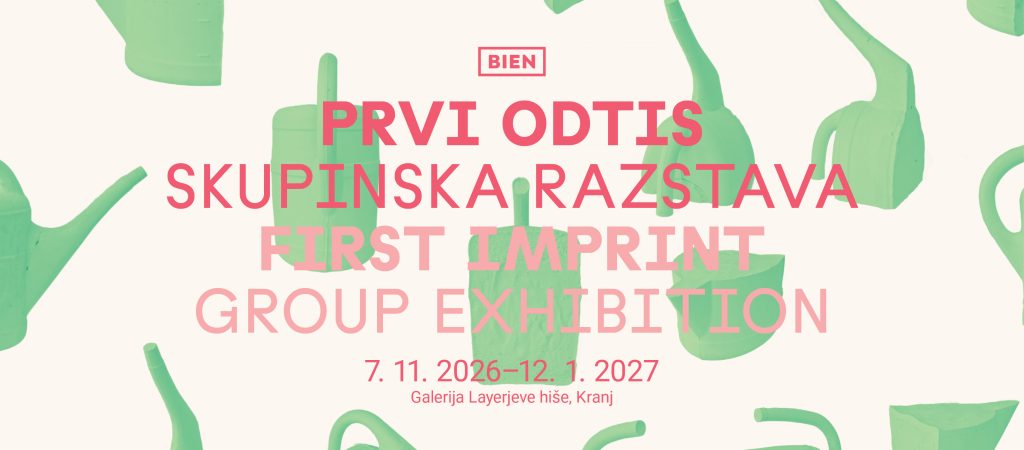
Opening on Saturday 7. 11. 2026 at 20:00
First Imprint
group exhibition
Taja Frešer, Doroteja Horvat, Zala Hrastar, Zarja Ivačič, Tamara Marinček, Maja Modrijan, Nika Očko, Estera Rezar, Roman Rus
Tekstilindus Archive: Margareta Vovk Čalič
Curator: Lovro Ivančić
Project Lead: Vita Ivičić
Art Director: Zala Orel
Mentors: Arianna Moroder, Alja Horvat, Armando D. Cosmos, Anđela Lukanović Rupprechter, Alenka Marsh
The exhibition presents the outcomes of the months-long Mini Textile Incubator mentorship programme, developed by the BIEN team to strengthen production opportunities and support young textile artists and designers at the beginning of their practice or as they return to exploring pattern design. The process began with research into the textile heritage and archival patterns of the Museum of Gorenjska, which participants transformed through field research, mentoring and experimentation into personal interpretations, contemporary patterns and spatial installations. The programme brought together knowledge from textile design, art and craft, enabling participants to develop their ideas from initial concepts to finished works.
Tradition, Memory and Contemporary Interpretations
The archival textile patterns of the Museum of Gorenjska provide a starting point for exploring how traditional motifs can be transformed into contemporary visual and spatial expressions. In Lamps, Doroteja Horvat explores rhythm, repetition and the layering of ornament, translating these elements into textile objects in which pattern interacts with light and space. In the On the Wings collection, Tamara Marinček draws on archival bird motifs and other traditional elements to create new compositions for scarves, translating heritage into a contemporary design language. Zala Hrastar, meanwhile, combines folk floral ornamentation with images of crumbling walls and old wallpaper. Through cyanotype and digital manipulation, she creates abstract patterns that bring together the organic and the raw, romance and imperfection.
Textiles also become a space for personal memory and imagination, transforming everyday objects into carriers of intimate stories. In Scissors Family, Maja Modrijan draws on a pair of inherited tailoring scissors connected to more than fifty years of family history, exploring belonging, labour and her own origins. Similarly, in Grandmother’s Flower Garden, Nika Očko revisits a sense of homeliness, intertwining it with an imagined bed set amid tall grass, the morning breeze and the scents of nature. Zarja Ivačič explores the intersection of intimate memory and bodily experience in The Nostalgia of Bruises, transforming images of bruises into textile patterns. Colours and marks on the body become a starting point for reflecting on experiences that remain inscribed in memory.
Other works explore material, movement and relationships shaped by repetition, transformation and the loss of control. In Construction of Fairness, Roman Rus examines the concept of fairness through the division and fragmentation of an everyday object. The cut elements become building blocks for a new pattern, intertwining questions of wholeness, difference and shared space in a reflection on relationships between individuals. In I Want to Fall / I’m Afraid to Fall, Estera Rezar translates the experience of skateboarding into patterns and a spatial textile sculpture, where the repetition of movements, mistakes and falls is reflected in worn surfaces and damaged materials. Taja Frešer, in Second Breath, explores the expressive power of black, the interplay of light and shadow, and the tensions between different textures, combining historical references with imagination and contemporary design.
A special place in the exhibition is given to Margareta Vovk Čalič’s Tekstilindus Archive, patterns from the former textile factory in Kranj that brings a direct trace of local industrial and design heritage into the exhibition. The archive reveals the historical foundations from which new interpretations of textile patterns emerge.
The exhibition reveals how a textile pattern can evolve from an archival record or traditional ornament into an independent artwork, a personal narrative or a spatial experience. Rather than treating heritage as an unchanging remnant of the past, the participants approach it as a living resource that can be reinterpreted and connected to contemporary questions of the body, memory, identity, relationships and the environment. Through diverse materials and creative approaches, pattern moves beyond its decorative function to become a carrier of meaning, a way of thinking and a means of forging new connections between past and present. The Mini Textile Incubator thus presents not only the outcomes of a mentorship process but also creates space for the development of new artistic practices and future possibilities in contemporary textile art.
Text: Zala Orel
Producer: Zavod Carnica
Partners: Gorenjski muzej, TAM-TAM Inštitut
Donor: Mercis d.o.o.
Sponsor: Tiska Tekstina d.o.o.
Co-financed by: Ministrstvo za kulturo, Mestna občina Kranj
Opening hours: Tuesday to Saturday, 11 am–7 pm. Closed on Sundays, Mondays and public holidays.