
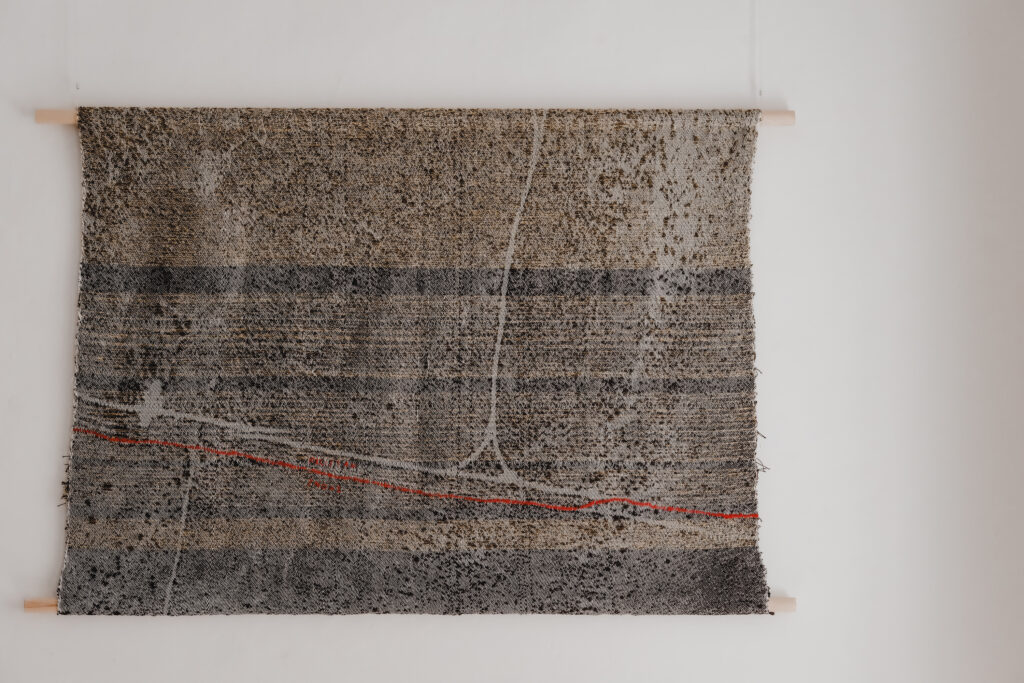
A woven aerial view of the India-Pakistan border of the crooked Radcliff Line was made to shift the perspective on the politics of borders and boundaries. In August 1947, after 300 years of rule, the British left India, leaving it partitioned into two nation states, Hindu-majority India and Muslim- majority Pakistan. Author’s paternal and maternal ancestral homes in the Punjab were abandoned and her families came to India as refugees. In one of the largest migrations in history, over fourteen million people crossed an arbitrary border, the Radcliff Line, drawn by British cartographer Cyril Radcliff. The forced mass migration resulted in the deaths of over two million people.
Savneet Talwar, PhD, is an art therapist, textile artist, and researcher. She employs stitching and mending as a form of slow activism. As a professor at the School of the Art Institute of Chicago, she teaches art therapy and textile studies, guiding students in exploring textiles as a material that can strengthen communities, foster interpersonal connections, raise awareness of social and political issues, and advocate for social change.
photo: Maša Pirc