
She heats the wax and pours it into the tjanting – carefully, so as not to burn herself. She picks up the ancient textile tool, feels its grip, its perfectly balanced weight – and the inscription flows across the silk as if by itself. Her hand, an extension of her thoughts, hovers gently above the silk sheet. It circles slowly at the wrist. The wax must not spill over the edge of the tjanting! It sizzles softly as the hot grease drips onto the precious silk and seeps into it. With a thin, glassy line, she gradually forms a script. She writes densely, from left to right, steadily, line by line. She textures uniform surfaces – the pages of her textile book. She meditates in silence. Before her hand tires, the wax cools. She melts it again and continues where she left off, until the entire surface is covered. She lifts it close to her eyes – as if peering through an elaborate sieve of her subconscious. The room is already saturated with the sweet scent of melting wax, yet she pulls in front of her a new, unwritten textile letter. She knows exactly how she will inscribe it. Always in the same ritual way – yet each time differently within that sameness. One day resembles the next, but no two are ever alike. Monotony is anything but dull.
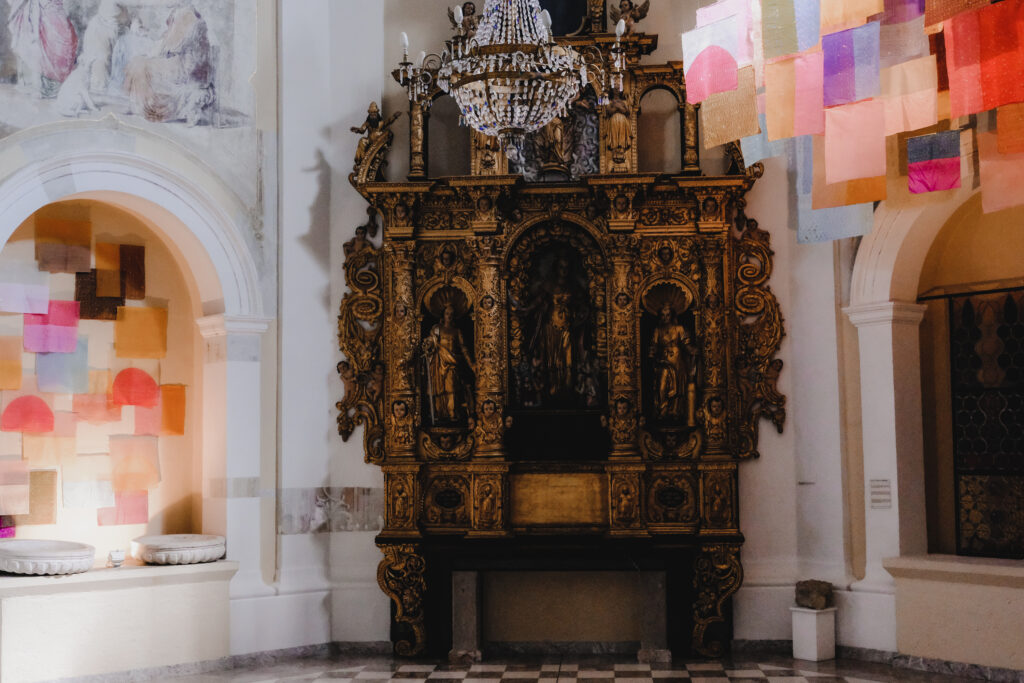
The life’s work of Vera Sešlar remains faithful to batik – the textile dye-resist technique using wax, which the artist reinterprets in her own distinctive way. She lives in harmony with wax and silk. She enriches dry silk with the nourishing fat, which she never removes. With wax, she draws on silk as if piercing it with light, saturating it more and more until it is completely infused. She openly reveals every step of her process. Her waxed script speaks to us through unique symbols, which evolve from drawn knitted loops to delicate outlines of trees, and finally transform into tiny crosses – traditional embroidered motifs.
The artist and associate professor Vera Sešlar Založnik comes from Maribor. In the 1970s, she studied at the University of Applied Arts in Vienna and later completed her postgraduate specialization. She works in batik on small pieces of silk and fine cotton. The batik technique originates from Java, Indonesia, where the word thika means to write or to draw.
photo: Maša Pirc