
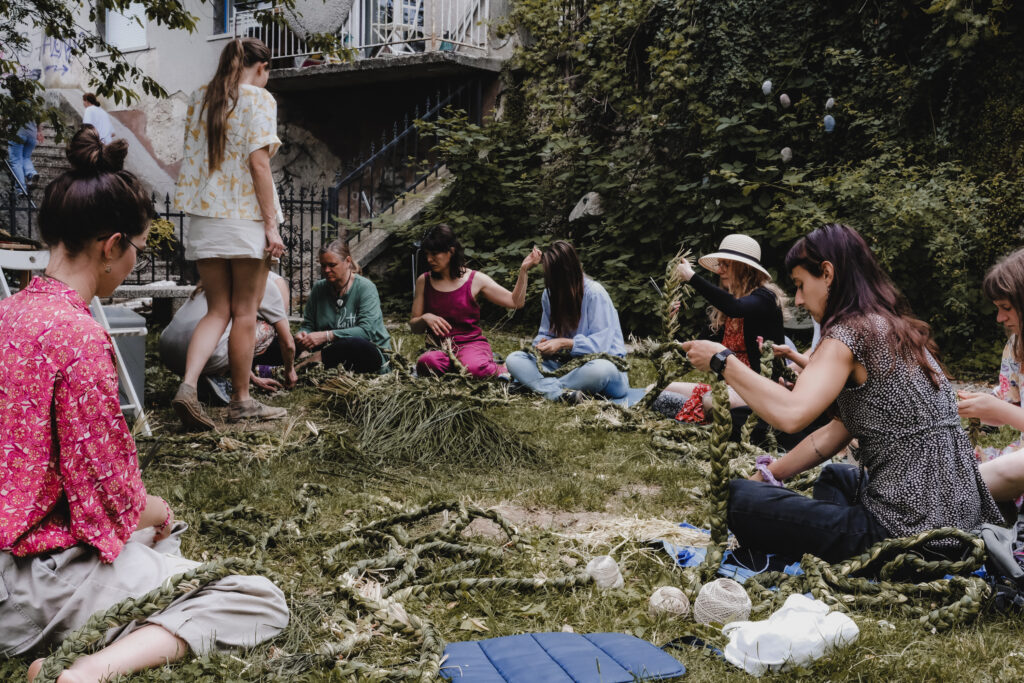
reTHREAD intertwines workshops, discussions, and creative sessions that foster the connection between well-being, nature, contemporary textile art, and handicrafts. The three-day program, designed under the guidance of artists, participatory designers, art therapists, craft communities, activists, and nature as a co-facilitator, offered creative encouragement, rhythm, and grounded presence. It targeted those looking to enhance their toolkit for professional or personal growth, as well as those seeking relaxation, inspiration, and a retreat.
The three-day program took place from Monday, 2 June to Wednesday, 4 June 2025 in Kranj.
About the program: https://layer.si/bien/en/kr/odmik
Video: https://www.youtube.com/shorts/LYX7AQ5Oll8
Mentors:
Savneet Talwar, PhD, is an art therapist, textile artist, and researcher. She employs stitching and mending as a form of slow activism. As a professor at the School of the Art Institute of Chicago, she teaches art therapy and textile studies, guiding students in exploring textiles as a material that can strengthen communities, foster interpersonal connections, raise awareness of social and political issues, and advocate for social change.
Prof. Dr. Art. Jasmina Pacek, Univ.Spec.Art.Therap. a Croatian-American artist and art therapist, teaches applied art and art therapy at the Academy of Arts and Culture in Osijek, Croatia. She focuses on using art therapy protocols, particularly the Expressive Therapies Continuum (ETC), to promote holistic brain function and personal growth among professional artists, students and variety of clients.
Mateja Kavčič is an academic painter trained at ALUO in Ljubljana, dedicated to landscape art, spatial installations, and creating with natural materials, emphasizing transience, rituals, and a deep connection with nature. Vita Ivičič is a designer educated at Chelsea College of Art & Design in London, merging traditional textile techniques with botanical printing and natural dyes while exploring indigenous craft practices such as hand-weaving linen fabric. They collaboratively develop artistic projects and lead intergenerational gatherings, using natural materials, tactile processes, and sustainable techniques as tools to deepen the bond with nature and fellow humans.
Patrícia Geraldes is a visual artist educated at the Faculty of Fine Arts in Porto. She explores the relationship between humans and nature through materials, traditional craft techniques, and installations. Her work engages in co-creation with communities in India, Spain, Portugal, and Italy. She collects stories, memories, and studies rituals, focusing on the intimate bonds we establish with materials. This is reflected in her commitment to sustainability and the reuse of materials such as wool, linen, wicker, and natural findings from forests, mountains, and beaches.
For two decades, Oloop collective, a team of three textile artists has been exploring the intersection of art, design, and socially engaged practices. Their work is internationally recognized and has received multiple awards, using textiles as a medium for sensory experiences, reflection, and community-based creation. Their artistic practice goes beyond the materiality of textiles—treating it as a space for inner processes that open dimensions of emotion, touch, and comfort.
Romana Brina Gobec is the founder of Brinas Studio, an experimental space where she explores the interplay of colors, nature, and sensory experiences. Her work is rooted in the study of natural dyes, textures, and pigments, revealing the unpredictability and beauty of natural materials. In Brinas Studio, she intertwines intuitive exploration, traditional techniques, and contemporary experimental approaches, creating unique, organic patterns.
For a decade, Nina Arnuš (cultural studies expert and art therapy student) and Anka Pintar (cultural sociologist and philosophy professor) have been leading Breja Preja, a community that fosters creativity as a nurturing space for the integration of immigrant women and intergenerational collaboration. They believe that art is for everyone. More important than the final appearance of a piece is the creative process itself and the awareness of what happens within us as we create. Their workshops explore various textile techniques, intertwining movement with textile-making, storytelling with embroidery, crochet with activism, and knitting with mindfulness.
No-Border Craft is a self-organized group of migrant women, asylum seekers, and activists who create a space for solidarity, intercultural exchange, and social integration through collective crochet. Their work goes beyond traditional craft gatherings—it is an activist project that raises questions about migrant women's rights and social visibility. The group emerged from a collaboration with the crochet collective KvaKvačkaš, where the crochet hook became a symbol of strength and connection.
Oljana Karpus is a Ukrainian therapist who merges ethnographic practices with contemporary art therapy. Her work explores deeply rooted cultural symbols and rituals that have served as tools for inner stability and personal transformation for centuries. After years of leading therapy groups in Kyiv, she dedicated herself to supporting women in crisis after relocating to Slovenia. Oljana's approach integrates creative expression as a means of emotional processing, empowerment, and self-worth recognition.
Matija Samec is the founder of "Gozdni tok", a platform that reconnects people with nature through forest therapy, sensory experiences, and therapeutic processes in natural environments. As a certified forest bathing guide with a background in integrative therapy, Pilates, and neurolinguistic programming, he combines knowledge from psychotherapy, neuroscience, and natural sciences to create safe spaces where individuals can process inner experiences, release worries, strengthen resilience, and reconnect with the living world around them.
The curator of reTHREAD program
Jasmina Ferček (SI)
Jasmina Ferček is a textile artist and art therapist. Through conversations with women, she explores the meanings and beneficial effects of their creative experiences with textiles. As a member of the Oloop collective, she works in the field of participatory and psycho-socially engaged textile art and design, co-creating and leading various women's groups—most often migrant women—for the past thirteen years.
She runs an independent art therapy practice and leads workshops, training sessions, and group sessions in art therapy. She occasionally lectures on the use of textiles and other visual media for therapeutic and counseling purposes at the Faculty of Education and the Faculty of Social Work at the University of Ljubljana.
Jasmina is an active member of the Slovenian Association of Art Therapists (SZUT) and a full member of the European Federation of Art Therapy (EFAT).
The program is part of Culture for Mental Health, supported by the Ministry of Public Administration of the Republic of Slovenia.
photo: Maša Pirc